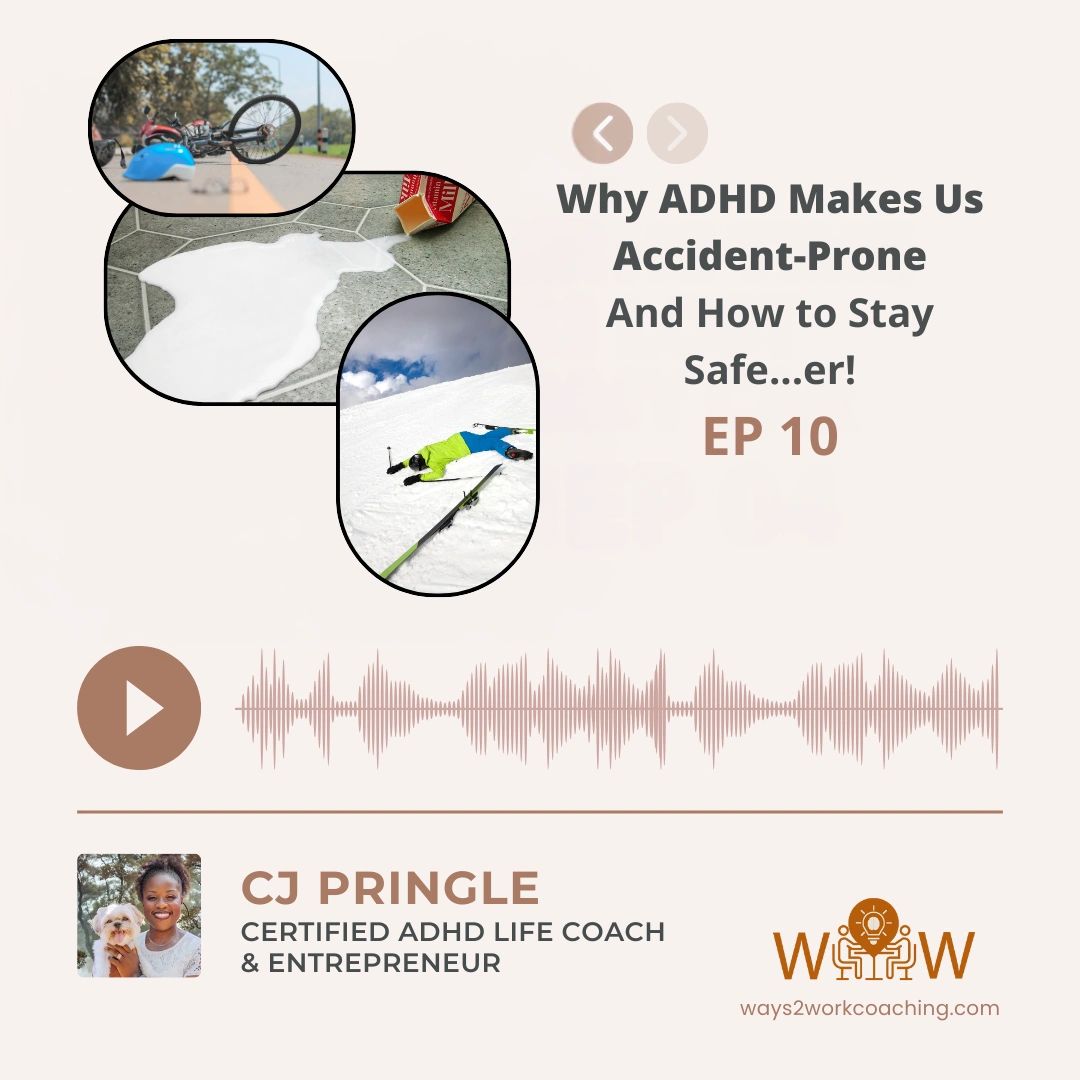
As I sat at my gate in the Reno, NV airport, fresh from a ski trip in Lake Tahoe, I reflected on a personal milestone: It was my first time skiing without a brace since having knee surgery. I tore my ACL skiing a few years prior, and this trip reminded me how often I’ve found myself injured.
From cycling mishaps to fights with a can opener, countless bruises from furniture, tripping down the stairs, running into walls, and people... it’s a long list. Not to mention the countless “Oops” moments (like spilling a giant Costco jar of minced garlic all over my kitchen floor… and my daughter’s bare feet. Or grabbing my smoothie from the top only to realize the top was not secure and have it slip out of my hand and splatter all over the carpet … and the ceiling.) I could literally go on for days.
These experiences got me thinking about yet another common result of living with ADHD: accidents. If you’re often sheepishly saying the words “Did I do that?” (said in my best Urkel voice), or accidents seem to find you more often than others, you’re not alone.
Let’s explore why ADHD can make us more accident-prone, and more importantly, what we can do to minimize those risks.
Why ADHD Makes Us More Prone to Accidents
Research shows that individuals with ADHD are more likely to experience accidents, both big and small. But why? Here are some key factors:
· Impulsivity– ADHD makes it difficult to think before acting -- and patience is not typically one of our strong virtues. Acting on impulse without fully thinking through the consequences can lead to risky decisions. Whether it’s skiing down a challenging slope without assessing the terrain or becoming impatient while handling a stubborn can opener with little to zero safety concern, these things increase the likelihood of accidents.
· Distractibility - ADHD brains are constantly processing stimuli, which can make it harder to focus on the task at hand. A momentary distraction while cycling, for example, can lead to losing control and taking a tumble… or five
· Sensory Processing Challenges- Some people with ADHD experience sensory processing differences, which can affect spatial awareness. This might explain why bumping into walls, furniture, or even people is a regular occurrence for many of us.
· Hyperfocus at the Wrong Times - Ironically, hyperfocus—one of ADHD’s superpowers—can also backfire. When you’re deeply engrossed in a task, you might neglect your surroundings, leading to mishaps like burning food or yourself in the kitchen, or tripping over something you didn’t notice.
My Personal Adventures in Accidental Mishaps
As I’ve mentioned, I’ve had my fair share of accidents that seem to illustrate these tendencies perfectly. The can opener incident? ADHD impulsivity turned a simple craving for pina coladas into a battle with a Bacardi can. The pull-tab broke, the can opener failed, and my impatience got the better of me. I decided to pry it open with my thumb—spoiler alert: the can won. Instead of pina coladas, I ended up with stitches and a scar as a permanent reminder.
One time, ADHD distractibility turned Samson’s potty break into an unplanned neighborhood tour. I let him out in our ungated backyard, got distracted making a sandwich, and completely forgot about him. Three hours later, as I’m driving off to my next engagement, my son calls (which never happens). That’s when it hit me—Samson! Thankfully, a neighbor five doors down found him and posted on Facebook after he wandered into their house. (Sorry Samson! ☹) Spoiler: Unfortunately, I didn’t learn my lesson the first time.
Distractibility on my road bike has also been particularly unkind to me over the years. I just got a flashback of me running into my husband as we approached a quiet 3-way intersection one fine Sunday morning… You know that “look both ways” rule? Well, I got distracted looking one of those ways and crashed right into Greg, who I thought had already proceeded forward. No… he had completed looking both ways and appropriately came to a stop. I think that was one of two incidents where he fell off his bike. The other incident was also my fault. (Sorry Babe! ☹)
On another ride, I was going too fast as I tried to make a turn not noticing the road’s pavement had become rougher than what we’d been riding. I lost my bearing and slid across the pavement. The amount of skin I lost and pain I felt that day is forever seared into my long-term memory. In fact, I was so focused on nursing those external wounds that I didn’t even realize I had damaged ligaments in my wrist which I apparently made worse over time and ultimately resulted in repair surgery almost a year later.
Yes, the stories are endless, but these experiences aren’t just anecdotes—they’re reminders of how ADHD can subtly (or not so subtly) impact our daily lives.
What We Can Do to Minimize Risks
While we can’t completely eliminate accidents, there are strategies that can help reduce the risks:
1. Slow Down – I’ve had to learn this the hard way unfortunately but it’s easier to remember as I’ve gotten older. But taking a moment to pause and assess a situation before diving in can make a big difference.
2. Build Awareness - Practice mindfulness to stay present in the moment. This can help reduce impulsive actions and improve focus on the task at hand.
3. Use Tools and Systems - Leverage tools like alarms, reminders, or even physical barriers to create safer environments. For example, using a safety glove when handling sharp objects in the kitchen or wearing protective gear (knee brace, helmet, elbow guards etc.) during physical activities.
4. Know Your Limits - It’s okay to acknowledge when something feels risky or beyond your comfort zone. I’ve accepted that when it comes to ski runs, I can’t keep up with Greg or the kids anymore. I mean… I could but I’d just be putting myself at more risk unnecessarily. So while they’re off skiing blacks and black diamonds, blues are my “happy place” and I’m ok with enjoying the mountain at a comfortable pace on my own. Trust your instincts and prioritize safety.
5. Embrace Support - If you’re prone to accidents in certain situations, don’t hesitate to ask for help or guidance. Sometimes, an extra set of eyes or hands can make all the difference. I’d much rather be slightly annoyed than immobile from another injury.
6. A Community of Resilient Thrivers- Living with ADHD means navigating a unique set of challenges, but it also means embracing creativity, resilience, and resourcefulness. By understanding the connection between ADHD and accident-proneness, we can take proactive steps to stay safe while continuing to live life to the fullest.
If you’ve had your own “ADHD accident” moments, I’d love to hear about them. Sharing our stories not only normalizes these experiences but also helps us learn from one another. Let’s keep the conversation going!